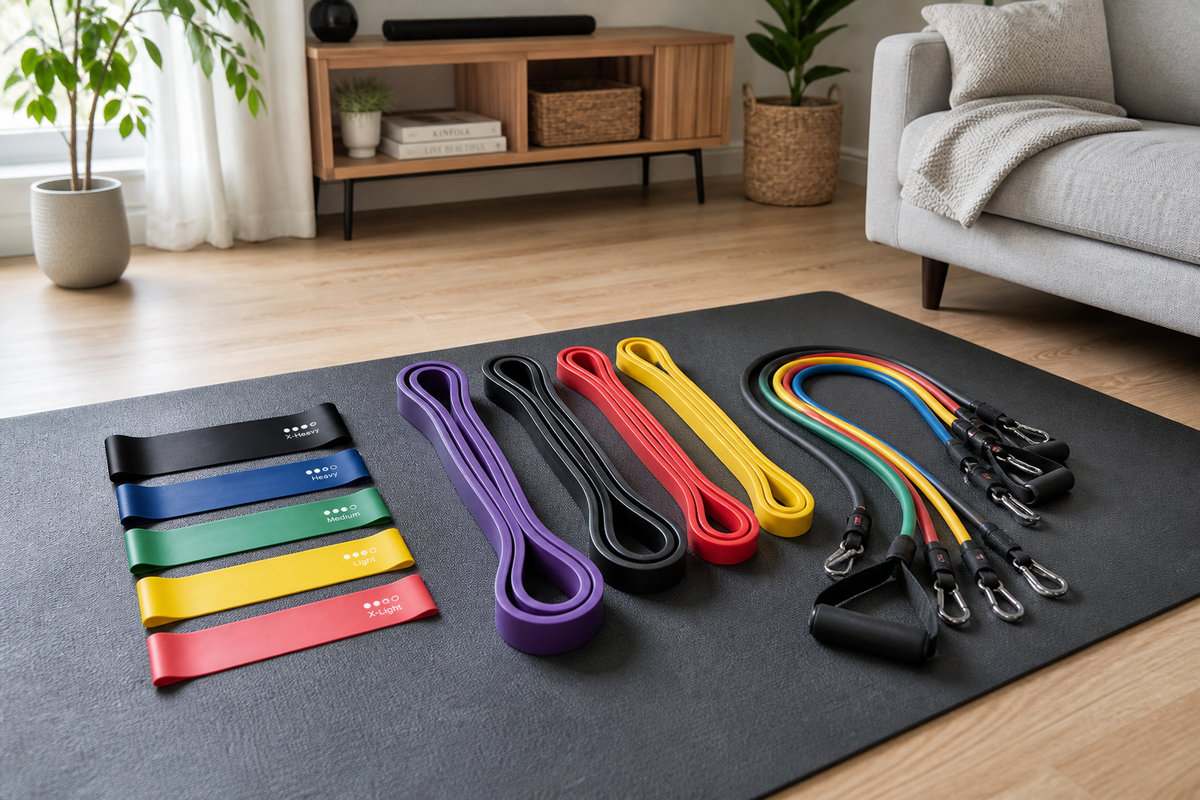
Choosing the best resistance bands for home workouts starts with matching the band to your exercises, strength level, and available space. The right option for glute activation is not always the right option for pull-aparts, assisted pull-ups, or full-body strength training. A good buying decision depends on band type, resistance range, material quality, and how you plan to progress over time.
For most home users, a small set with multiple resistance levels is more useful than a single heavy band. Lighter bands help with warm-ups, mobility, and shoulder work, while medium and heavy bands are usually better for lower-body exercises and strength progressions. If you are comparing options, focus first on training goal, then on construction and resistance range.
Start With the Main Types of Resistance Bands

Resistance bands are not interchangeable. Different shapes and lengths change how the resistance feels and which movements they support best.
Mini loop bands
Mini loop bands are short, closed-loop bands usually used around the thighs, knees, ankles, or wrists. They work well for glute activation, lateral walks, core drills, and some rehabilitation exercises. They are less useful for full upper-body pressing and rowing patterns.
Long loop bands
Long loop bands are continuous flat bands that can support a wide range of home strength exercises. They are commonly used for rows, presses, squats, deadlift variations, assisted pull-ups, stretching, and mobility drills. For many people, this is the most versatile format for full-body training.
Tube bands with handles
Tube bands often come with handles and sometimes door anchors. They can feel familiar to people who want cable-style exercises at home, such as chest presses, rows, curls, and triceps extensions. Their usefulness depends heavily on handle quality, attachment points, and how securely they anchor.
Therapy or rehab bands
Therapy bands are usually flat, non-looped strips with lighter resistance. They are most useful for physical therapy drills, mobility work, and very controlled beginner movements. They are generally not the best choice for heavier lower-body strength training.
If your goal includes general strength work in a small space, resistance bands in loop formats are usually the most practical starting point.
Match the Band to Your Training Goal
The best band depends on what you want to do with it. Buying by exercise goal prevents the common mistake of choosing a band that is either too limited or too heavy to use correctly.
| Training goal | Best band type | Why |
|---|---|---|
| Glute activation and lower-body warm-ups | Mini loop band | Stays in place well for short-range lateral and activation drills |
| Full-body strength training | Long loop band | Supports presses, rows, squats, hinges, and assisted bodyweight work |
| Cable-style home exercises | Tube band with handles | Works well for presses, curls, rows, and triceps movements |
| Mobility and rehabilitation | Therapy band or light loop band | Allows controlled, lower-load movement patterns |
| Travel or small-space workouts | Mini loop or long loop band | Lightweight, compact, and easy to store |
If your workouts center on lower-body activation, Pilates-style training, or short resistance circuits, a Pilates accessories setup may overlap well with mini bands and mobility tools.
Choose the Right Resistance Level

Resistance level matters more than color alone. Colors are not standardized across brands, so a medium band from one manufacturer may feel very different from a medium band from another.
Most beginners do best with a set that includes light, medium, and heavy resistance rather than a single band. This allows proper loading for different body parts, because shoulders and arms usually need less resistance than squats, hip hinges, and glute work.
How to test whether a band is the right level
- If you cannot control the full range of motion, the band is too heavy.
- If you can do far more than your target reps with little effort, the band is too light.
- If tension only appears at the very end of the movement, the band may be too slack or too long for that exercise.
- If form breaks down before the target muscles fatigue, resistance or setup should change.
A useful starting point is to choose a set that lets you perform roughly 8 to 15 controlled repetitions for strength-focused exercises and higher reps for mobility or activation work. For people building a compact home gym equipment setup, multiple band strengths are usually more useful than one extra-heavy option.
Check Material, Build Quality, and Safety

Band durability affects both training feel and safety. The main materials are latex and fabric, and each behaves differently.
Latex bands
Latex bands usually provide smoother stretch and a wider resistance range. They are common in long loop and therapy-style bands. However, they can snap as they age, especially if exposed to heat, sunlight, rough surfaces, or overstretching.
Fabric bands
Fabric bands are common for mini loops used in lower-body training. They tend to roll less and feel more comfortable against the skin during glute and hip exercises. They usually do not replace long loop bands for broader full-body strength work.
What to inspect before buying or using
- Visible cracks, thinning, fraying, or uneven texture
- Strong chemical odor that may indicate lower manufacturing quality
- Weak seams on fabric bands
- Handle attachments or carabiners that look poorly secured
- Resistance markings that are unclear or missing
Before each workout, inspect bands for wear and avoid anchoring them to sharp edges or unstable doors. Safety matters more as band tension increases.
Consider Space, Setup, and Exercise Variety
Home workouts work best when the equipment is easy to use consistently. A band that is technically versatile but awkward to anchor or store may end up unused.
Long loop bands are often the simplest option for people training in apartments or shared rooms because they need little floor space and minimal setup. Tube systems can be helpful, but they often require more accessories, such as handles or anchors, to unlock their full exercise range.
If your broader routine includes low-impact cardio in a small room, equipment choices often work better together when they are compact and easy to move, such as a walking pad paired with portable strength tools.
Best Buying Approach for Most Home Users
For most people, the most practical choice is a multi-band set rather than one single band. That gives enough range for upper body, lower body, warm-ups, mobility, and progression.
- Choose long loop bands if you want the most versatility for full-body strength training.
- Add mini loop bands if you want better lower-body activation, glute work, or short circuit sessions.
- Pick at least three resistance levels so you can scale exercises correctly.
- Check the material, seams, and attachment quality before relying on a band for heavy tension.
- Replace bands that show cracking, fraying, or loss of elasticity.
If you want one format that covers the widest range of home workouts, long loop bands are usually the safest general recommendation. If your training is more focused on activation, mobility, or Pilates-style lower-body work, mini loops may be the better primary option.
FAQ
Which resistance band is best for beginners at home?
For most beginners, a set of light to medium long loop bands or mini loop bands works best. A set is more useful than one band because different exercises require different resistance levels.
Are fabric or latex resistance bands better?
Fabric bands are often better for lower-body activation because they usually roll less and feel more stable. Latex bands are generally more versatile for full-body strength work because they stretch more smoothly and come in more formats.
How many resistance bands do I need for home workouts?
Three resistance levels are enough for most people to start. This usually covers lighter upper-body work, moderate full-body movements, and heavier lower-body exercises.
Can resistance bands build strength at home?
Yes. Resistance bands can build strength when the band tension is challenging enough, exercises are progressed over time, and sets are performed with good form and controlled effort.


Laat een reactie achter
Deze site wordt beschermd door hCaptcha en het privacybeleid en de servicevoorwaarden van hCaptcha zijn van toepassing.